

Foundation settlement rarely starts with obvious damage. Most of the time it shows up as small changes that are easy to explain away. However, the issue is that settlement does not usually stop on its own. For this reason it is important for homeowners and property owners to be aware of the early signs of foundation settlement.
How Foundation Settlement Starts
Foundation settlement starts when the soil supporting the structure can no longer carry loads evenly. This usually happens below grade, out of sight. Changes in moisture cause certain soils to swell, shrink or soften. Poorly compacted fill can compress further under building weight. Erosion can also remove fine particles that help distribute load.
As foundation soil conditions change, support is lost in specific areas rather than across the entire foundation. One section may remain stable while another settles. It is that uneven support that creates bending and rotation within the foundation system.
The structure above will then respond to this imbalance. Loads that were once spread evenly begin to concentrate along slabs, beams, walls, and connection points. Stress then transfers upward into framing, finishes, exterior materials, etc.
However, when early signs are identified, movement can often be evaluated and controlled before load redistribution affects larger portions of the building! Keep reading to know what to look out for.
Sign 1: Small Interior Wall Cracks
Let’s start out small. Interior wall cracks are often the first thing people notice. They tend to show up quietly and are easy to explain away at first.
Common places these cracks appear:
- At the upper corners of doors and windows
- Along drywall seams / ceiling joints
- Where walls meet ceilings
- Near stair openings or long hallway walls
At this stage, movement is usually minor. The foundation is adjusting and the framing above it is responding.
Cracks that reappear after patching, slowly grow or show up in multiple areas tend to point away from simple drywall issues and more toward foundation movement below the structure.
Sign 2: Doors and Windows that Start Sticking
Doors and windows rely on square openings to work correctly. And when a foundation shifts, those openings move out of alignment.
Early on, this might feel seasonal. Maybe a certain door rubs slightly in the summer but works fine later. If foundation settlement is the culprit, the sticking will become more consistent over time.
This is because the structure above the foundation is being twisted / pulled as support changes below. This goes without being said, but fixing the door itself will not address the root cause.
Sign 3: Uneven or Sloping Floors
Floor movement is often felt before it is measured. People might notice furniture that rocks or a floor that “feels off”.
In slab foundations, this can happen when soil below the slab settles unevenly. In pier and beam foundations, it may show up as sagging between supports.
Be careful, because these changes usually happen slowly. For this very reason, they often go unnoticed until the difference becomes more pronounced and thus more severe.
Sign 4: Cracks in Exterior Brick or Masonry
Exterior masonry does not tolerate movement well. When the foundation shifts, stress transfers into brick, stone, or block walls instead of being absorbed.
Early warning signs often seen outside:
- Stair step cracking along mortar joints
- Diagonal cracks near windows or doors
- Separation forming at corners
- Cracks that follow a repeating pattern across several bricks
- Mortar joints opening wider in one direction
Since masonry is rigid, it only makes sense that these foundation cracks are reflecting movement happening below the wall rather than just surface aging or weather exposure.
Sign 5: Gaps Around Trim, Cabinets, Ceilings
As a structure moves, interior finishes respond quickly. These materials are stiff and tend to separate when framing shifts.
Here are some areas you may notice gaps forming:
- At crown molding or baseboards
- Where cabinets meet walls or ceilings
- Along built in shelving
- At ceiling transitions or soffits
- Around interior door trim
These gaps can often start small. When they widen, spread to other rooms, or return after being filled, they usually indicate uneven movement rather than normal material shrinkage.
Sign 6: Exterior Separation at the Foundation Line
Believe it or not, some of the earliest concrete settlement clues show up outside the building. These are easy to miss…unless you regularly walk the perimeter.
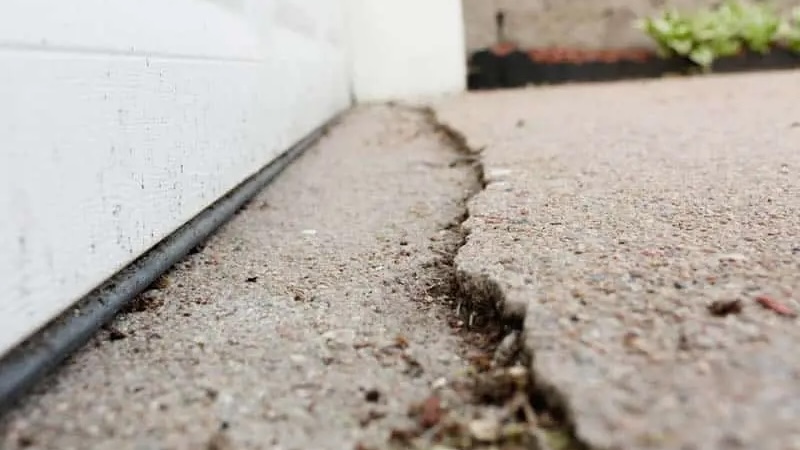
Things to watch for are soil pulling away from the foundation, gaps forming between siding and the foundation, voids forming near corners, or separation at brick ledges. These signs often indicate that the soil supporting the foundation is changing shape or losing volume.
Questions? Reach out to the concrete leveling specialists at Leveled Concrete!
Signs That Do Not Always Point to Foundation Settlement
Not every crack or sticking door means a foundation problem. Some conditions can look concerning but stay cosmetic or seasonal. The difference is usually consistency, location, and progression.
Examples that do not always point to settlement (AKA false signs):
- Isolated drywall nail pops or small cracks that appear once and do not change
- A single hairline crack in drywall or masonry that stays the same size
- Doors or windows that only stick during periods of high humidity
These issues might just come from normal material movement, humidity changes or construction. On their own, they are not always a problem.
However, concern starts to set in when multiple signs appear together, show up in the same areas or get worsen over time. Patterns like these outweigh any single symptom.
Get a Foundation Evaluation with Leveled Concrete
Leveled Concrete works with homeowners and building owners across the Great Houston area to evaluate early foundation movement and identify any possible foundation problems. Our concrete repair team reviews soil conditions, foundation behavior, and structural response to determine the right path forward. We have years of experience in concrete leveling, driveway repair, sidewalk repair, pool deck repair, and many more concrete lifting services.
If you are seeing early signs of foundation settlement in your residential or commercial building, do the smart thing and schedule an inspection ASAP.